
When a borrower fails to repay a secured loan, banks require an effective legal mechanism to recover their dues without prolonged court proceedings. This is where the Securitisation and Reconstruction of Financial Assets and Enforcement of Security Interest Act, 2002 plays a crucial role. The SARFAESI Act is particularly significant for NRIs and their families because many of them avail themselves of home loans, loans against property, and business loans from Indian banks and financial institutions by pledging their properties or other secured assets in India. In the event of a loan default, banks may initiate recovery proceedings under the SARFAESI Act. Therefore, understanding this act is essential for every NRI who owns property or has borrowed from an Indian bank.
Overview of SARFAESI Act, 2002 for NRIs
The Securitisation and Reconstruction of financial Assets and Enforcement of Security Interest Act, 2002 commonly known as the SARFAESI Act, was enacted to enable banks and financial institutions to recover their dues from defaulting borrowers without first obtaining a decree from a civil court. Before this Act came into force, banks used to file civil suits, and recovery often took several years. The SARFAESI Act introduced a faster legal mechanism by allowing secured creditors to enforce their security interest after following the procedure laid down in the Act. The Act applies to secured loans, where the borrower has offered an asset such as house, commercial property, land machinery or other valuable property as security for the loan.
Importance of SARFAESI Act for NRIs
As far as NRIs are concerned, the SARFAESI Act is extremely important because many NRIs and NRI families frequently take loans in India for purchasing residential property, buying commercial property, expanding a business, loans against property or for making financial investments. To get these loans, NRIs generally pledge their properties or other assets located in India as security with Indian banks and financial institutions.
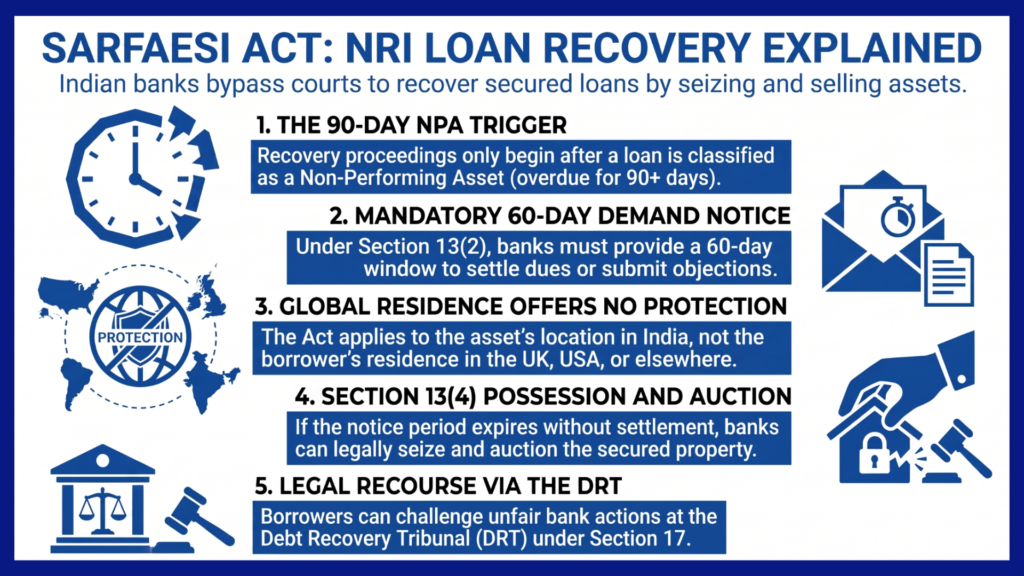
However if the NRI fails to repay the loan and the account is classified as a Non-Performing Asset (NPA) under the RBI’s prudential norms, the bank acquires the right to initiate recovery proceedings under the SARFAESI Act. After following the procedure prescribed by law, the bank may take possession of the mortgaged property and, if necessary, sell it to recover its outstanding dues.
One of the biggest misconceptions among NRIs is that living outside India protects their Indian property from legal action by banks. This is not true. The SARFAESI Act applies to the secured asset located in India, not to the borrower’s place of residence. Therefore, whether the borrower lives in the United Kingdom, Canada, the United States, Australia or any other country, Indian banks can still enforce their security interest over the mortgaged property situated in India if there is a loan default.
For Example, Suppose an NRI living in the UK purchases a house in Chandigarh by taking a home loan from an Indian bank. If the borrower stops paying the EMIs and the loan account becomes an NPA, the bank can issue a demand notice under Section 13(2) of the SARFAESI Act. If the borrower fails to repay the outstanding amount within the prescribed period, the bank may proceed to take possession of the property and auction it in accordance with the Act. The fact that the borrower is residing abroad does not prevent the bank from taking these legal steps.
Step 1. Understanding NPA (Non-Performing Asset) The starting point of recovery proceedings.
When people hear about the SARFAESI Act, they often think that banks can immediately seize or auction a borrower’s property after a loan default. This is a common misconception, The SARFAESI process does not begin with property possession or auction; it starts only after the borrower fails to pay the interest or installment of principal that remains overdue for more than 90 days.
A common misunderstanding is also that if a borrower misses one EMI, the bank can immediately classify the account as an NPA. This is not true. For Example suppose EMI due date is 1st January and borrower does not pay the EMI the bank may issue reminders and charge late payment penalties, but the account will not become an NPA immediately. If the payment continues to remain unpaid and the overdue period crosses 90 days, only then can the bank classify the account as an NPA. An NPA is the starting point of the SARFAESI recovery process. Without NPA, the bank cannot proceed to issue the statutory demand notice under Section 13(2) of the SARFAESI Act.
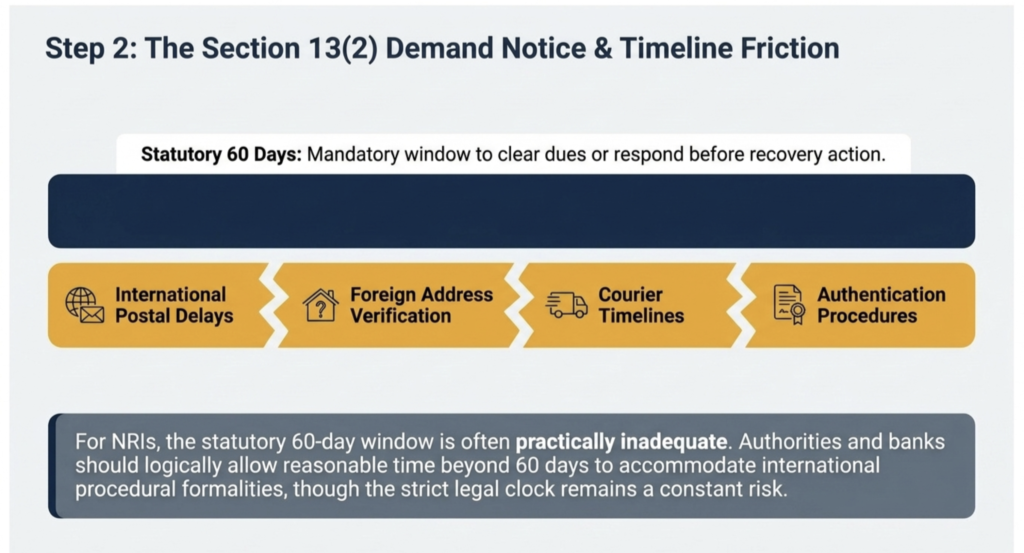
Step 2. After an account becomes an NPA the bank serves a Demand notice under Section 13(2) of the SARFAESI Act. This notice is mandatory. Without issuing this notice, the bank cannot proceed to take action under Section 13(4).
The notice gives the borrower 60 days from the date of receiving the notice to clear the outstanding dues or respond to the bank. It acts as a final opportunity for the borrower to resolve the default before the bank starts recovery proceedings.
Note for NRIs: For NRIs 60 days time may not be practical or reasonable in many cases. Since NRIs reside outside India, the notice often takes considerable time to reach them due to international postal delays, address verification, courier timelines, and other procedural formalities. In addition, various compliance requirements and authority procedures (such as service of notice through prescribed models, verification of foreign address, authentication to due process) take additional time.
Therefore, the 60 days notice period is generally not preferred or considered adequate for NRIs. Banks and authorities should allow a reasonable and fair time beyond 60 days for NRIs to respond or make arrangements.
Step 3: During the notice period, the borrower has several options like:
- He/She repays the entire outstanding amount, which will stop further SARFAESI proceedings.
- He/she negotiates a One Time Settlement or any other settlement with the bank.
- He/she can request for restructuring or rescheduling of the loan, if the bank’s policies permit.
- He/she submits the objections or representations if the borrower believes the bank’s claim is incorrect or the account has been wrongly classified as an NPA.
Step 4: If the borrower neither repays the dues nor reaches a settlement within the 60 days notice period, the bank becomes entitled to take measures under Section 13(4) of the SARFAESI Act. These measures may include taking possession of the secured asset, taking over the management of the secured business, appointing a receiver, selling or auctioning the secured asset to recover the outstanding dues.
Step 5: If a borrower believes that the bank has acted unfairly, illegally, or in violation of the SARFAESI Act, the borrower has a legal right to challenge the bank’s actions before the Debt Recovery Tribunal (DRT) under Section 17 of the SARFAESI Act. DRT is a SARFAESI appellate forum. When a bank takes measures of section 13(4) then borrowers have an option to approach the DRT. The Debt Recovery Tribunal does not simply assume that the bank is right. Instead, it independently examines whether the bank has complied with the SARFAESI Act. The tribunal considers questions such as:
- Was the loan account validly classified as an NPA?
- Was the mandatory demand notice under Section 13(2) properly served?
- Did the bank provide the borrower with the statutory 60-day period?
- Were the borrower’s objectives considered in accordance with law?
- Did the bank follow the SARFAESI Act and the Security Interest (Enforcement) Rules, 2002?
- Was possession of the secured asset taken lawfully?
- Was the auction conducted in a fair and legally compliant manner?
The DRT examines both the facts and the legal procedure before deciding whether the bank’s action is valid.
Debt Recovery Tribunal
The DRT can determine whether the bank has complied with the provisions of the SARFAESI Act and the Security Interest (Enforcement) Rules 2002. The Security Interest Enforcement Rule provides the detailed procedure that the banks must follow to take possession of value, and sell secured assets under the SARFAESI Act while protecting the legal rights of borrowers.
- Power to examine the Legality of the Bank’s action.
- Power to declare the Bank’s Action Invalid.
- Power to Set aside Possession.
- Power to Restore Possession to the Borrower.
- Power to Cancel an Illegal Auction.
- Power to Protect the Borrower’s Rights
- Power to Confirm the Bank’s Action.
- Power to Pass Appropriate Orders.
Types of Loans covered under SARFAESI:
- Mortgage: The borrower mortgages an immovable property like House, Flat, Commercial building Factory.
- Hypothecation: It is applicable on movable assets like vehicles, machinery, stock, inventory etc.
- Pledge: It is also used for gold, shares, fixed deposits or other movable securities. These assets act as security for the repayment of the loan.
SARFAESI does not apply to personal loans, Credit card dues, and agricultural land for not being auctioned. However, this protection is available only if the land is genuinely agricultural in nature and is used for agricultural purposes. If the land is used for commercial, industrial, residential, or other non-agricultural purposes then the exemption under Section 31(i) may not apply.
In K. Sreedhar v. M/S Raus Construction Pvt. Ltd (2023). The Supreme Court clarified that section 31(i) of the SARFAESI Act protects only land that is actually used for agricultural purposes. Merely describing the land as agricultural in revenue records is insufficient. If the borrower cannot prove that agricultural activities were being carried out on the land, the bank is entitled to its security interest and proceeds with auction under the SARFAESI Act.
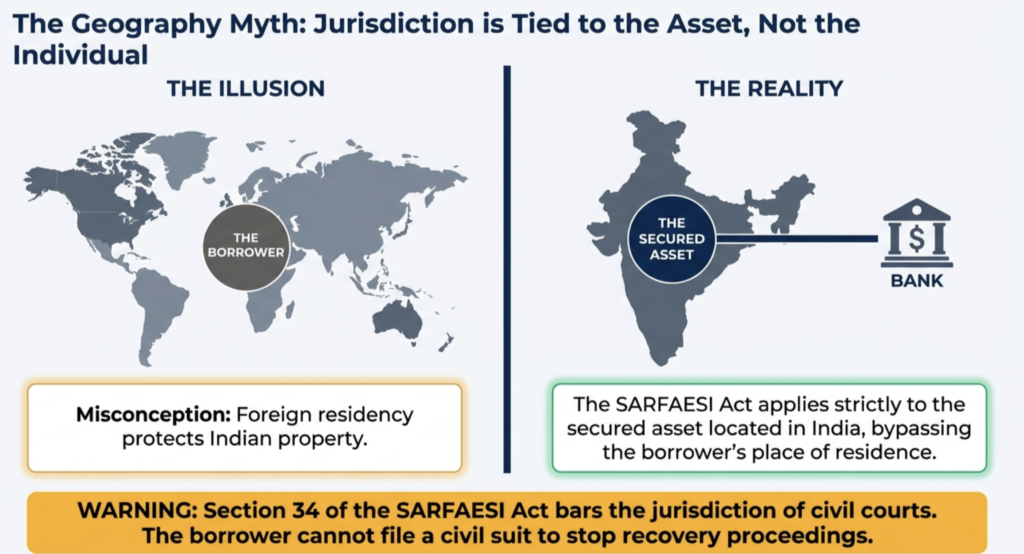
Under Section 34 of the SARFAESI Act, 2002, the jurisdiction of civil courts is barred in matters where the Debt Recovery Tribunal (DRT) has the authority to decide disputes under the Act. Therefore, if a bank takes recovery measures under Section 13(4), the borrower cannot file a civil suit to stop the proceedings. Instead, the borrower must file an application before the DRT under Section 17, the DRT examines whether the bank has complied with the provisions of the SARFAESI Act and the security Interest (Enforcement) Rules, 2002. If the DRT finds that the bank acted illegally or violated the prescribed procedure, it may set aside the bank’s action, restore possession of the secured asset, or grant any other appropriate relief.
For more information contact NRI Legal World: info@nrilegalworld.com / +919709692096
Frequently Asked Questions:
Q1. Does the SARFAESI Act apply to NRIs?
Ans. Yes, the SARFARSI Act applies to NRIs if they have taken a secured loan from an Indian bank or financial institution and have created a security interest (Such as a mortgage) over property in India. Living abroad does not exempt an NRI from recovery proceedings.
Q2. Can an Indian bank initiate recovery proceedings against an NRI’s pledged property after the loan account becomes a Non-performing Asset?
Ans. Yes, if the loan account becomes an NPA and the bank follows the procedure prescribed under the SARFAESI Act, it can enforce its security interest against the secured property located in India.
Q3. Will an NRI receive a 60-day notice before recovery of loan action entitled by the bank under SARFAESI Act?
Ans. Yes, after the loan account is classified as an NPA, the bank must issue a Demand Notice under Section 13(2) giving the borrower 60 Days to repay the dues or respond before taking measures under Section 13(4).
Q4. Can an NRI challenge the bank’s action against the pledged property?
Ans. Yes, if the bank takes measures under Section 13(4), the borrower can file an application before the Debt Recovery Tribunal (DRT) under Section 17 to challenge the legality of the bank’s action.
Q5. Can an NRI stop the auction of pledged property by clearing the loan amount?
Ans. If the outstanding dues are cleared before the sale is completed and the applicable legal requirements are satisfied, the bank may stop it and its possibility depends on the facts of the case and the applicable legal provisions.
Q6. Can an NRI submit objections to the bank after receiving the Section 13(2) notice under SARFAESI Act?
Ans. Yes, the borrower may submit objections or representations within the notice period. The bank must consider them and communicate its decision before proceedings further.
Q7 Does an NRI get any special exemption from the SARFAESI Act?
Ans. No. The SARFAESI Act applies equally to resident Indians and NRIs. However, NRIs enjoy the same legal safeguards available to every borrower, including the right to receive statutory notices and the right to approach the DRT if the bank violates the law.