
In today’s global economy, Indian residents increasingly require access to international financial, markets and overseas opportunities. Whether it is funding a child’s education abroad, paying for medical treatment, investing in foreign stocks, purchasing property overseas, or simply supporting family members living outside India, transferring money internationally has become a regular part of financial planning for many Indians.
To facilitate such legitimate overseas transactions while maintaining proper regulatory oversight, the Reserve Bank of India (RBI) has introduced the Liberalised Remittance Scheme, popularly known as the LRS that allows resident Indians to send a certain amount of money abroad without needing any special permission for each and every transaction they need to make.
How much money can you send abroad?
Under the LRS scheme, a Resident Indian can remit up to USD 250,000 as per financial year (1 April to 31 March). This scheme applies to every family member individually including the minors (through their natural guardian). Each Resident Indian has a separate limit of USD 250,000 per financial year.
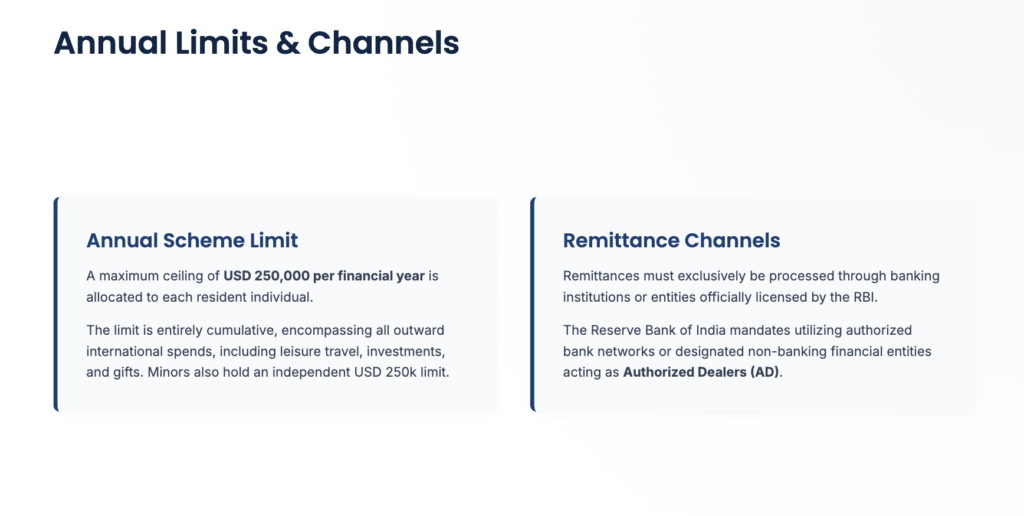
For example: If a family consists of four resident members (two parents and two minor children), each member has an individual limit of USD 250,000 hence, together the family can remit up to USD 1,000,000 in one financial year, provided each remittance complies with RBI regulations and is made through an authorised dealer or bank.
The USD 250,000 limit is an annual limit, not a lifetime limit. The limit resets at the beginning of every financial year.
Tips: The Liberalised Remittance Scheme does not apply to the NRI, PIOs, Overseas Citizens of India (OCIs), foreign nationals, Companies, Partnership Firms, Limited Liability Partnerships (LLPs) etc.
Who can use the Liberalised Remittance Scheme?
The Liberalised Remittance Scheme is available exclusively to resident individuals as defined under the Foreign Exchange Management Act, 1999. This means that an individual who is ordinarily residing in Indian and qualifies as a resident under FEMA can avail of the scheme and send money abroad for permissible purposes. The scheme is not restricted to salaried employees or business owners. Any resident individual who satisfies the residency requirements can utilise the facility.
For Example, a resident individual may use LRS to pay university fees for a child studying abroad, invest in foreign shares, purchase overseas property, provide financial support to family members living outside India, or meet medical expenses incurred overseas.
Minors are also eligible to benefit from the scheme. Since minors cannot independently enter into financial transactions, the remittance is made through their natural or legal guardian, who completes the necessary banking formalities on the minor’s behalf. An important feature of the scheme is that every eligible individual receives a separate annual remittance limit of USD 250,000. Therefore, a family consisting of parents and children may collectively utilise multiple individual limits for joint investments or other permissible purposes.
Who Cannot Use the Scheme?
Although LRS offers considerable flexibility, it is not available to everyone. The scheme is specifically intended for resident individuals and therefore cannot be used by persons or entities that do not satisfy this condition. Non-Resident Indians (NRIs) are not eligible because they are already governed by separate FEMA regulations applicable to non-residents. Similarly, persons of Indian Origin (PIOs) and foreign nationals residing outside India cannot utilise the scheme. Business entities are also excluded from the scope of LRS. Companies, Limited Liability Partnerships (LLPs), partnership firms, trusts, societies, and other artificial legal entities cannot remit funds under this facility.
RBI-Approved purposes for Sending Money Abroad Under the Liberalised Remittance Scheme (LRS)
The Liberalised Remittance Scheme (LRS) introduced by the Reserve Bank of India (RBI) provides resident individuals with considerable flexibility to remit money abroad. However, this flexibility is subject to specific conditions. The remittance must be made only for permissible current or capital account transactions approved by the RBI and must comply with the provisions of the Foreign Exchange Management Act (FEMA) 1999.
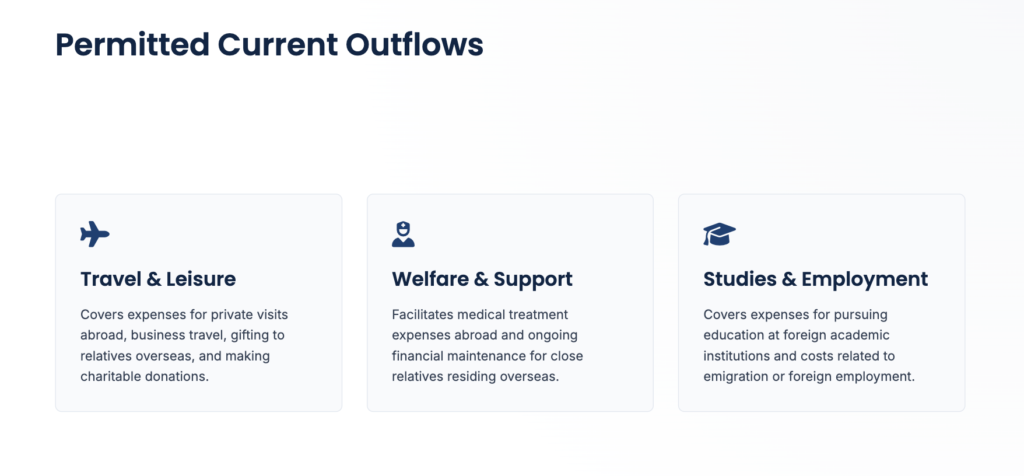
Below are some of the major RBI approved purposes for sending money abroad under LRS:
- Resident Indians can remit funds for private visits or international travel, including expenses such as accommodation, transportation, meals, and other travel-related costs.
- LRS permits remittances for pursuing education abroad. The funds may be used for tuition fees, hostel or accommodation charges, examination fees, or other educational expenses.
- Individuals may remit money for medical treatment outside India.
- Resident Indians are allowed to send gifts or make donations to persons or charitable organisations abroad within the prescribed LRS limit.
- LRS allows Resident Indians to diversify their investments internationally. Permitted investments include:
- Purchase of shares of listed foreign companies.
- Investment in foreign mutual funds and Exchange traded funds (ETFs).
- Purchase of debt securities and other eligible financial instruments.
- Acquisition of immovable property outside India.
- Emigration Expenses: Individuals planning to settle abroad permanently may remit money to meet expenses relating to immigration, visa, processing, settlement costs, and other requirements associated with emigration.
- Maintenance of close relatives abroad.
- Employment and career opportunities abroad.
Transactions Not Permitted Under LRS:
Although the Liberalised Remittance Scheme is designed to provide flexibility, certain transactions remain prohibited. Resident individuals cannot use LRS for.
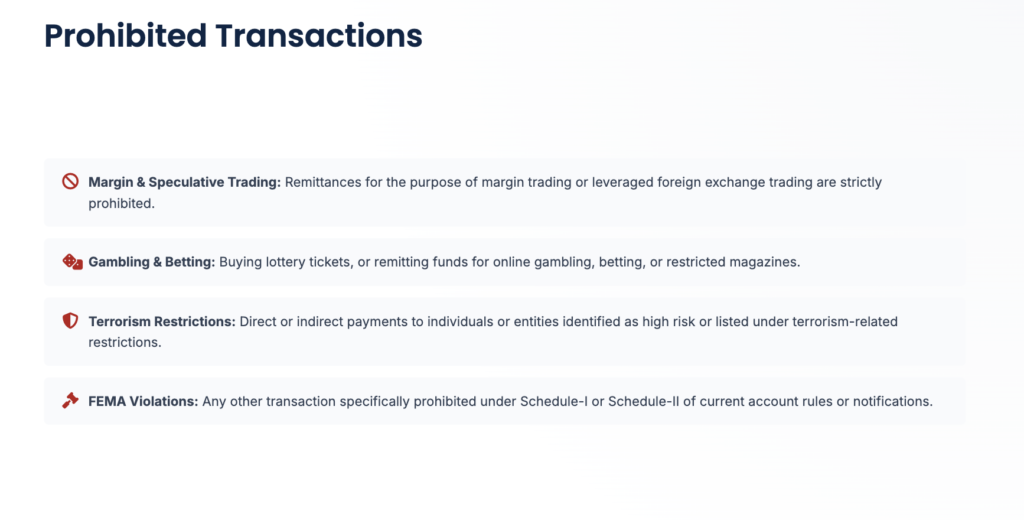
- Purchase of lottery tickets.
- Gambling or betting activities.
- Margin trading or leveraged foreign exchange trading.
- Remittances to individuals or entities identified by the RBI or Government of India as involved to terrorism or unlawful activities.
- Any transaction specifically prohibited under the Foreign Exchange Management Act (FEMA) or other applicable laws.
Tax Collected at Source (TCS) on sending money aboard:
Under the revised guidelines effective form April 1, 2026, the TCS rates for foreign remittances for each financial year have been updated as below:
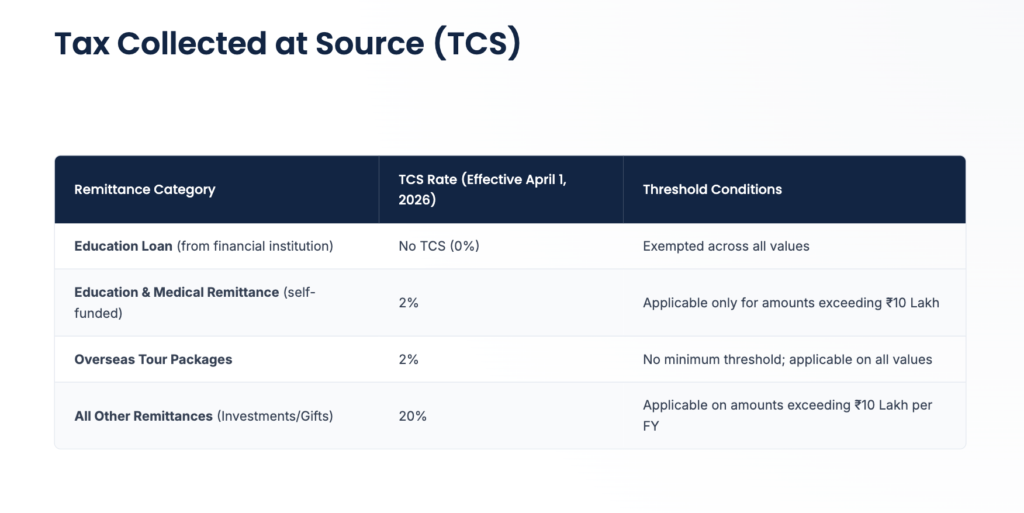
- No TCS will be applicable for education loans obtained from a financial institution for all values. 0% TCS on education loan.
- For other educational remittance, i.e self funded education, which is not covered by an education loan, and medical purposes the rate of TCS is 2% for the amount above ₹10 lakh.
- Overseas tour packages attract a TCS of 2% with no minimum threshold.
- All other remittances face 20% TCS for the amounts exceeding ₹10 lakh.
Refund Tips: Any TCS paid can be claimed as refund or offset against total tax reliability when filing ITR in India.
Important Requirements for sending Money Abroad
Before remitting money abroad under the Liberalised Remittance Scheme, a resident individual must fulfil certain requirements prescribed by the Reserve Bank of India RBI. He/she should ensure that they have a valid PAN, routing the remittance through an Authorised Dealer (AD) bank, staying within the annual remittance limit of USD 250,000, and ensuring that the source of funds is genuine and legally earned. The remittance must also comply with the Foreign Exchange Management Act (FEMA), 1999, the prevention of Money laundering Act (PMLA), 2002, and the provisions of the Income tax Act 1961, including the applicable Tax Collected at Source (TCS). Meeting these requirements helps ensure that overseas remittances are processed smoothly and remain fully compliant with Indian Law.
Contact: info@nrilegalworld.com / +919709692096 for more details.
Frequently Asked Questions:
Q1.Can a resident individual gift money to NRI/OCIs?
Ans. Yes, a resident individual can gift money to his close relative NRI/OCIs within the LRS limit of 250,000 lakhs USD dollars. Gifts can only be made through a banking channel to the NRO account of NRI/OCI.
Q2. Which document is mandatory for sending money abroad?
Ans. PAN Card is mandatory for sending money abroad under the LRS scheme.
Q3. Is TCS paid by resident Indians under LRS refundable?
Ans. Resident Indian can claim refund of TCS paid under LRS scheme
While filing his income tax return in India if no tax is payable or
tax is paid in excess.
Q4. Which are the relatives to whom resident Indian can gift money
under the LRS scheme?
Ans. Resident Indian can gift money to his following NRI/PIO relatives
Under LRS:
- Husband/Wife.
- Father/Step father
- Mother/Step mother.
- Siblings.
- Children.
- Relatives
Q5. How much Money Can an Indian Send Abroad?
Ans. Under the Liberalised Remittance Scheme (LRS) of the Reserve Bank of India (RBI), a resident Indian can remit up to USD 250,000 per financial year (1 April to 31 March) of permitted current and capital account transactions. This limit is per individual and includes all remittances made during the financial year, irrespective of the purpose. The amount can be used for overseas education, medical treatment, foreign travel, maintenance of close relatives, gifts, investments abroad, purchase of property and other RBI approved purposes.
For example, if a resident individual spends USD 100,000 on overseas education and USD 50,000 on foreign investment during the same financial year, only USD 100,000 remains available under the LRS limit.
Q6. Can an Indian resident Invest Money Abroad?
Ans. Yes, a resident Indian is permitted to invest money abroad under the Liberalised Remittance Scheme (LRS), subject to the annual limit of USD 250,000 and compliance with RBI and FEMA regulations.
Q7. What is the Limit for an Indian to Send Money Abroad?
Ans. The maximum amount a Resident Indian can remit abroad under the Liberalised Remittance Scheme is USD 250,000 per financial year. Some important points about this limit are:
- It is an annual cumulative limit, not a limit for each transaction.
- It covers all eligible remittances made during the financial year, irrespective of the purpose.
- The limit resets every financial year on 1 April.
- Every eligible resident individual has a separate limit of USD 250,000 including minors (through their natural guardian).
- All remittances must be through an Authorised Dealer (AD) Bank after complying with RBI, FEMA, and Income-tax requirements.